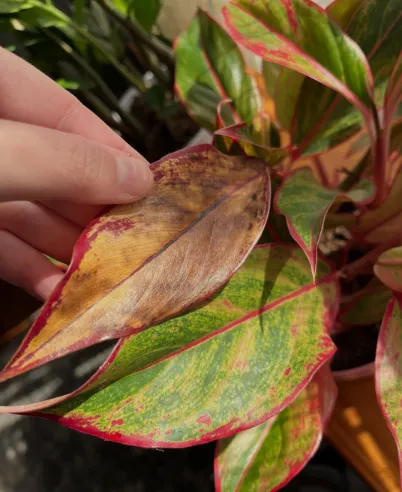
You brought home a beautiful aglaonema lipstick — vivid red edges, glossy leaves, the whole thing. Then, a few weeks later, the tips start going brown. Don’t panic. This is one of the most common aglaonema complaints, and in most cases, it’s completely fixable once you know what’s causing it.
The tricky part is that brown tips can show up for more than one reason, and each cause has a slightly different look. This guide will help you read the signs, find the culprit, and know exactly what to do about it — without any guesswork.
Quick diagnosis guide
| Low humidity Tips turn brown and feel dry and crispy. Rest of leaf looks fine. ↑ Mist or use a pebble tray | Underwatering Edges brown and curl inward. Soil is bone dry. Leaves droop slightly. Water deeply, let drain | Cold drafts Brown edges appear suddenly, often on one side facing a window or vent. Move plant, block draft |
Cause 1: Low humidity
This is the most common cause of brown tips on aglaonema lipstick, and it makes sense once you know where the plant comes from. Native to the tropical rainforests of Southeast Asia, it evolved in environments where humidity sits well above what most homes can offer. Ideally it wants 50–70% humidity. The average living room sits somewhere around 30–40%.
When the air around your plant is too dry, moisture evaporates from the leaf tips faster than the roots can supply it. The result is those telltale crispy brown ends — starting at the very tip and working inward, like the leaf is slowly drying out from the edges.
How to spot it
The browning starts right at the leaf tip and feels dry and papery to the touch. The rest of the leaf usually looks healthy and green — this isn’t a whole-leaf problem, just the extremities. It tends to get worse in winter, when central heating dries the indoor air significantly.
The fix
You have a few options, and using more than one works even better. The most effective long-term solution is a small humidifier placed about a metre from your plant. It raises the ambient moisture without ever wetting the leaves directly.
If a humidifier isn’t an option, a pebble tray works well — fill a shallow tray with pebbles and a little water, and sit the pot on top. As the water evaporates upward, it keeps the air around the plant more humid. Just make sure the pot isn’t sitting in the water itself, which can cause root rot.
You can also group your aglaonema with other houseplants. Plants naturally release moisture as they transpire, and a cluster of plants creates its own little humid microclimate. Misting directly on the leaves is the most common advice you’ll see, but use it carefully — damp leaves left overnight can invite fungal problems, especially in low-airflow rooms.
The humidifier placement rule

Place a humidifier about 1 metre away from your plant — close enough to raise the ambient humidity, far enough that the mist doesn't land directly on the leaves. Consistently wet foliage can lead to fungal leaf spots, which is a problem you don't want to swap in for brown tips.
Cause 2: Underwatering
People are often so worried about overwatering their aglaonema (with good reason — root rot is a real risk) that they swing too far the other way. Underwatering has its own distinct look, and once you know it, it’s easy to tell apart from a humidity issue.
When the plant isn’t getting enough water, the leaves start to curl inward at the edges — almost like they’re trying to conserve what little moisture they have. The tips and edges go brown, but the whole leaf feels dry and slightly limp, not just the tips. The soil, if you check it, will be very dry well below the surface.
How to spot it
Check the soil first. Push your finger one to two knuckles deep — if it’s completely dry all the way down, underwatering is likely your culprit. The leaves will often feel soft or slightly deflated rather than firm and upright. You may also notice the plant drooping more than usual in the middle of the day.
The fix
Water thoroughly — not a little splash, but a proper deep watering until water runs out of the drainage holes. This ensures the entire root zone gets moisture, not just the top layer. Then let the pot drain completely before putting it back in its saucer.
Going forward, aim to water when the top inch of soil is dry to the touch. In summer, that might mean every 7–10 days. In winter, every 14 days or more. The plant’s needs shift with the seasons, so a fixed schedule often isn’t reliable — checking the soil before you water is a much better habit.
Bottom soaking for very dry soil

If the soil has dried out completely and is pulling away from the pot edges, normal top-watering can run straight through without actually wetting the root ball. Try bottom soaking: place the pot in a tray of water for 20–30 minutes and let the soil absorb moisture from below. Drain thoroughly afterwards.

This is a rescue method, not a regular one — it works well for a severely dehydrated plant but isn't needed for routine care.
Cause 3: Cold drafts and temperature stress
Aglaonema lipstick is a tropical plant through and through, and it does not cope well with cold. Temperatures below 15°C (60°F) stress the plant noticeably, and sudden exposure to cold air — even briefly — can trigger rapid browning along the leaf edges.
The tricky thing about cold drafts is that the damage can appear suddenly and on one side of the plant, seemingly out of nowhere. You might come home one morning to find an entire row of browning edges that weren’t there the day before. The culprit is often a window cracked overnight, an air conditioning vent blowing directly at the plant, or a spot near a front door that gets blasted with cold air every time someone comes in.
How to spot it
Cold draft damage tends to affect the side of the plant facing the source — you’ll often see browning on the leaves closest to a window or vent. The browning runs along the edges of the leaf rather than starting at the tip, and it can appear fairly quickly after a temperature event. If you also notice the leaf curl inward, that’s another classic sign of cold stress.
The fix
Move the plant. That’s really the primary fix here — no amount of misting will undo repeated cold exposure. Find a position away from windows that are opened in cold weather, and well clear of air conditioning vents, exterior doors, and heaters. A consistent room temperature between 18–27°C (65–80°F) is the sweet spot.
One thing people miss: avoid watering with cold tap water in winter. Running cold water directly onto a tropical plant’s roots can cause a similar kind of temperature shock, showing up as brown edges even if the air temperature is fine. Let tap water sit for an hour before use, or use room-temperature water from a stored can.
Check for hidden draft sources

Hold a lit incense stick or a piece of tissue near where your plant sits — if it wavers, there's air movement you might not have noticed. Common hidden draft sources include gaps around window frames, letterboxes, and the gap under external doors. Moving the plant just a metre away can make a real difference.
A few other things that can cause brown tips
Humidity, underwatering, and cold drafts are the big three, but a couple of other factors are worth knowing about.
Tap water quality. Aglaonemas are sensitive to fluoride and chlorine, which are present in most tap water. Over time, these build up in the soil and cause tip burn — brown, slightly bleached tips that worsen slowly rather than appearing suddenly. If you’ve ruled out the other causes, try switching to filtered or room-temperature water left to stand overnight (which allows some chlorine to off-gas).
Over-fertilising. Too much fertiliser causes salt build-up in the soil, which draws moisture away from the roots and can burn the leaf tips in much the same way as drought stress. Stick to feeding every 4–6 weeks during spring and summer only, and use a balanced fertiliser at half the recommended strength.
What about the brown tips that are already there?
Once a leaf tip has turned brown, it won’t go back to green — that tissue is gone. But you can tidy it up without removing the whole leaf. Use clean, sharp scissors to trim the brown portion away, following the natural curve of the leaf as closely as possible. The result looks much neater and doesn’t harm the plant at all.
Just make sure you’ve addressed the underlying cause first — trimming the tips while the problem persists just means you’ll be trimming again in a few weeks.
Common questions
My aglaonema only has brown tips on one side. Why?

Uneven browning is almost always a clue to the source — the affected side is likely facing a draft, direct airflow from a vent or fan, or a cold window. Rotate the plant and observe whether new browning continues to appear on the same side.
Can I prevent brown tips entirely?

Almost — with consistently good humidity, appropriate watering, and a stable warm position, most aglaonemas will stay tip-brown-free. The occasional tip may still brown on very old leaves as a natural part of ageing, which is nothing to worry about.
My plant has brown tips and yellowing leaves at the same time. What's going on?

Brown tips with yellow leaves is often a sign of two things happening at once — dry air causing the tips to brown, and overwatering causing the yellowing. Check both your humidity levels and your watering frequency. It sounds contradictory, but both problems can exist together.
How long does it take to see improvement after fixing the cause?

Existing brown tips won't recover, but you should stop seeing new browning within 2–3 weeks of addressing the root cause. New leaves that emerge should come in healthy. If browning continues after that, there may be a second cause worth investigating.
The short version
Brown tips on aglaonema lipstick are almost always environmental — dry air, inconsistent watering, cold exposure, or a combination of all three. None of these are serious plant emergencies. Identify which pattern fits your plant, make the adjustment, trim the damaged tips, and watch for healthy new growth. Your aglaonema is tougher than it looks.
More gentle guides to indoor plant care at zenofwatering.com — because the best plant parents pay attention.
SEO targets
aglaonema lipstick brown tips, why is my aglaonema turning brown, aglaonema brown leaf tips fix, aglaonema lipstick care problems. chinese evergreen brown tips, aglaonema humidity requirements